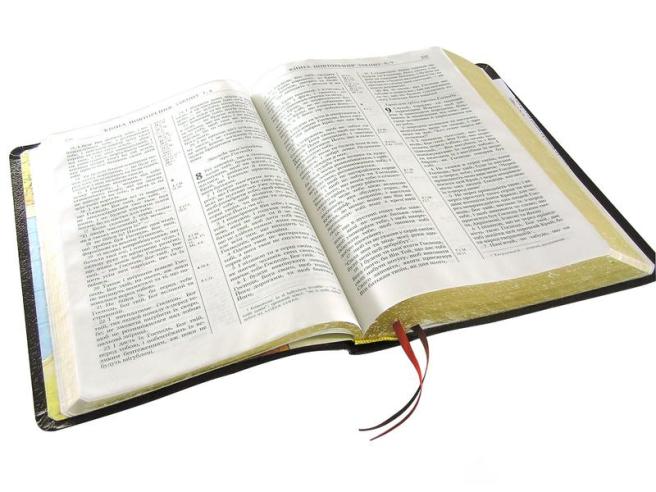
We owe a huge debt of gratitude to such people who dedicated their life’s work (and in some cases lost their lives) in order to make the Bible accessible to all who want to read it and we have never had it so good. Bible translation is currently happening in 3,283 languages in 167 countries! English language Bibles range from the John Wycliffe produced a complete translation of the Bible into English in 1382, shortly before he died. He was denounced as a heretic for this work by the Roman Catholic Church. By the mid 1500’s other men such as William Tyndale and Miles Coverdale had also completed English translations. Tyndale was hounded by the Roman Catholic Church for this and burned at the stake in 1536.
William Morgan, a Welshman who studied languages in Cambridge University alongside Tyndale and Coverdale, dedicated himself to the huge task of producing a Welsh Bible from the original Hebrew and Greek. By 1587 he had completed this work and presented a copy of the Welsh Bible to Queen Elizabeth I. He wrote in his dedication to the Queen “Unless religion is taught in the common tongue it will remain hidden and unknown”.
We owe a huge debt of gratitude to such people who dedicated their life’s work and in some cases lost their lives) in order to make the Bible accessible to all who want to read it and we have never had it so good. Bible translation is currently happening in 3,283 languages in 167 countries!
English language Bibles range from the traditional 1611 King James Version (KJV) through to more modern English versions such as the English Standard Version (ESV) and New International Version (NIV) – and many more, including the convenience of free online accessibility.
And thanks to the work of William Morgan, there have been over 12 translations of the whole Bible into Welsh, including colloquial Welsh.
There is no excuse for not trying to read the Bible; some parts of the Bible can still be a difficult book to read and understand. However, it offers the hope of everlasting life in God’s Kingdom when the Lord Jesus Christ returns to this Earth.
We will be starting “Learn to read the Bible Effectively”, weekly seminars, for 6 weeks from Tuesday, 22 October 2024, God willing. They will be at 7pm, at our hall (110 Pontardulais Road Gorseinon SA4 4FQ). Please come along if you are interested.
It may seem obvious to you that the concept of hell as a place of eternal fiery torment is a Biblical concept, and that the Bible teaches that this is where ‘bad’ people go after death for eternal, fiery punishment! If you look online or to encyclopaedias for information about Biblical hell you will only find mainstream Christianity’s teaching about it. And if you research that more carefully, you will find that it was an idea which was developed in the centuries after the Bible was written.
However, our English bibles are translated from the original languages of Hebrew (Old Testament) or Greek (New Testament) so the English words we read are not the original written words in their native tongue. The main words which have been translated ‘hell’ in English are the words ‘Sheol’ (Hebrew), ‘Hades’ (Greek) and ‘Gehenna’; some modern Bible translations leave the original words in place sometimes and this can help when we understand what was originally meant by these words. Both Sheol and Hades simply mean the grave, or a pit, a covered place – this is what was understood by people when they read the Bible originally.
The third word, ‘Gehenna’, was the name of a valley to the south of Jerusalem in Bible times where people would take rubbish. There was always a fire and anything could be burnt, even the bodies of criminals. It was a place where things were destroyed (not tormented) by fire.
Consequently it is used in the New Testament as a metaphor for destruction, and is sometimes translated as ‘hellfire’.
If you read the Bible for yourself with an enquiring mind and open-minded research you can find out real truth. It isn’t as scary as you may have been told.
We are starting new “Learn to read the Bible Effectively” seminars in October 2024, God willing – please come along!
Have you heard of Wendell Morgan or maybe met him whilst walking in or around Gorseinon? He’s a local character who’s lived here his whole life; he loves this area and still lives in the same house that he lived in as a child. His family came here for employment at the steelworks following a terrible pit disaster in Senghenydd in 1913. 439 miners lost their lives in the disaster and Wendell’s family decided that a change of career for his father was needed.
Wendell was born in 1935 when many diseases were prevalent in Wales. We don’t see many of these any more due to childhood vaccinations being freely available. One of these was Diphtheria, which is a potentially fatal contagious bacterial infection that mainly affects the nose and throat, and sometimes the skin. Unfortunately, Wendell contracted this illness at just 5 years of age and spent 5 weeks in a hospital bed with no visitors allowed because of the risk of infection. He spent so long being inactive that he had to learn to walk again, but he survived and regained his health. Wendell and his family felt very fortunate, as many children at Garngoch hospital died from the illness.
Following this difficult patch the family remained healthy and well and two years later Wendell’s older brother went away to serve in the merchant navy when he was only 16 years old. He wasn’t away for long when he was reported missing in action which was devastating news for the whole family. This was made especially difficult because shortly after receiving the news his father was required to go to Birmingham to work for 3 years until the end of the war. It was during this time that Wendell’s mother really struggled as they hardly ever saw his father and she was desperate for news of her missing son. She decided to go to the Spiritual church in Kingsbridge to try to contact her son but this didn’t help. It was 3 years before the family were formally told that their son/brother had died. It was a very sad time for their whole street as five families all lost a young man, or boy, to the second World War.
At the age of 13 Wendell started playing football in Garden Village and loved the game. One Saturday when he was 17 he was playing in Underhill park in Mumbles and a scout from Cardiff City was attending. After the game Wendell was invited to go for a practice game the following week, and after the game he was asked to sign up as a professional player. He played for Cardiff’s second team for a year before going to the army. Wendell was called up for national service aged 18 but he had already worked for 3 years prior at various jobs: at the steel works and repairing cars locally. It was a very different time for teenagers then.
The Korean war was happening at this time and quite a few boys from Gorseinon were sent there; it was so cold they got frostbite. Wendell was glad he wasn’t sent there, he was in the Hussars tank regiment and was taught to drive tanks and rescue lorries. Wendell continued to play football in the army; they had a good team with 3 or 4 professionals in it. Wendell fondly remembers that the footballers and boxers were given special treatment in the army. They had special accommodation and better food than the other conscripts! Afterward, Wendell was posted to Germany, and his contract with Cardiff was cancelled as he couldn’t get there often enough to play. He continued playing football in the regiment in Germany and was offered a professional contract and a job by a local team when he finished in the army after 2 years service. He decided against taking this offer because his parents had already lost one son and they wanted Wendell to come home.
Wendell returned home to his family and shortly after was offered a contract playing football with Brentford. He took the offer and played for 3 years, staying with relatives in the area. He was then bought by Gillingham where he played for one season. After that he was bought by Swansea Town so he returned home again. Wendell played for the Swans for one season then transferred to Newport for a season followed by Llanelli for another season, after which he finished his football career. Wendell, however, never lost his love for the game and was keen to put his skills to good use locally. It was in the early 1970’s that someone suggested he should start a youth soccer club in Garden Village; this football team hadn’t started back again after the war, due to losing so many players. Wendell along with others on a committee helped with training, admin and finance for about 8 years. After this some of the seniors started a senior side and the club is still active today (https://www.facebook.com/gardenvillageafc)! Several players have been chosen from this team to play professionally; Leighton James was selected to play for Wales and another player was signed by the Swans.
Wendell’s work with the Garden Village football club was helped not only by his football career but also with his work in accountancy. He started this work after his football career ended and he joined a small group of local accountants. His career continued as Wendell became a member of certified accountants and then amalgamated with chartered accountants. He went on to study taxation, failing the first time but passing the second and became a member of the Certified Taxation Accountants. This led him to a varied career including a year spent between Australia working on the railways in Sydney & Perth and in the Government tax department in New Zealand. When his mother died in 1981 Wendell decided to become self-employed and started work from the front room of his home. This proved to be an excellent choice – he was so busy he had to employ another person to help with the workload and it kept Wendell busy until his retirement.
Unlikely as it may seem, given such an eventful and varied life, this led to the focal point of Wendell’s life – his belief in God and hope for the future kingdom of God on the earth. He grew up in a family that had a faith and attended the Church in Wales, where he was a keen member of the choir. He was ‘baptised’ there when he was 17 with a sprinkling of water on his head, but he didn’t have much understanding of the Bible. It was later in life in his mid-fifties or maybe early sixties when he started to think again about his knowledge and beliefs. He was encouraged by friends to join them in Bible reading seminars which were being held in Swansea with the Christadelphians.
Wendell says,
“I enjoyed the lessons very much and learnt a lot. I wanted to learn more and I heard that there were Christadelphians in Gorseinon so I went along there and continued to read my Bible and understand more. After about 9 months I realised that I needed to be baptised by full immersion in water and I asked them to arrange this for me. I understood there was urgency and that Christ could return any day. My faith has had a huge impact on my life – it gives me such a wonderful hope for the future. This world is full of non-believers, as the Bible says it will be, but I love to share my faith and hope, and I talk about God’s Word to anyone who will listen. I try hard to lead a life that is an example and encouraging to others (although I often fail). I have been a Gorseinon Christadelphian for many years and I encourage anyone interested to come along and learn for themselves.”
Wendell has attended regularly since then and has enjoyed contributing over the years by keeping the accounts and serving on the welfare committee, and in many other ways. He enjoys arranging regular breakfasts for the men/boys of all ages on occasional Saturday mornings at the Roma café. When he was a little younger he enjoyed visiting the Christadelphian care home in Mumbles and helping out on their welfare committee. He no longer drives and spends his time closer to home, especially in his garden and enjoying long walks around the local area.
1. The word “gospel” means: a) revelation b) teaching c) good news
2. The gospel Jesus taught was about: a) becoming immortal b) the kingdom of God c) praise and worship
3. This gospel was also taught to: a) Abraham b) David c) Nebuchadnezzar
4. God’s future kingdom will be: a) on Earth b) in Heaven c) in the Afterlife
5. Jesus will reign as king from: a) Damascus b) Mecca c) Jerusalem
6. This kingdom is also defined as: a) the restored Kingdom of Israel b) the new Kingdom of the Angelic Saints c) the blessed Kingdom of the East
7. Another crucial part of the gospel is: a) having faith in the name of Jesus Christ b) following the Jewish law c) taking a pilgrimage to the holy land
8. If we do this, we believe that Jesus will: a) welcome us into heaven b) remove our free will so we cannot sin c) resurrect the dead when he returns
9. For this reason, we are commanded to: a) be christened b) be baptised c) be buried in Jerusalem
10. We must also confess and believe that: a) Jesus is God b) Jesus is the Christ, the Son of God c) Jesus went to heaven without dying
Answers:
1. C (Acts 13:32)
2. B (Luke 8:1; Matthew 24:14; Mark 1:14-15)
3. A, B, C (Galatians 3:8; 2 Samuel 7:12-17; Daniel 2:44-47)
4. A (Acts 1:11, Habakkuk 2:14)
5. C (Luke 1:31-33; Isaiah 2:2-4)
6. A (Acts 1:6-7; Jeremiah 23:5-8; Isaiah 11:10-12)
7. A (John 3:16)
8. C (John 11:25; 1 Corinthians 15:21-23, John 3:13)
9. B (Romans 6:3-4; Matthew 28:18-20; Gal 3:27)
10. B (Matthew 16:16-18; John 20:31; 1 Timothy 2:5)
Did these answers surprise you? If you have any questions or comments for us, or want to know more about the gospel of Jesus Christ and the Kingdom of God, please reach out via our website or social media channels. Alternatively, visit us on Sundays from 2-3pm at 110 Pontardulais Road, Gorseinon. SA4 4FQ. We would love to hear from you!
Have you ever gazed at a breathtaking mountain vista or marvelled at the intricate workings of the human body and wondered: is this all just a cosmic accident, or is there a designer behind it all? The sheer complexity and beauty that we see in nature points to an intelligent designer, much like a skilled engineer crafting a machine. The human body is a prime example, intricate proteins like Kinesin play essential roles in our cellular functions. These marvels of design are not random occurrences but the work of a purposeful creator – God.
Kinesin – a molecule transport mechanism in cells
We don’t look at trains transporting cargo or lorries distributing goods and try to work out how they could have occurred by accident or by chance, it’s an absurd notion! But many are happy to assume this of organic material.
The Bible clearly identifies God as the architect of the universe. He is responsible as the creator and sustainer of everything we see. It’s reassuring that we have a purpose in life and within the universe. World events and our very lives unfold within God’s grand plan, leading ultimately to a future kingdom of God on Earth.
Why not join us on Sunday, 16th June, 2024 at 12.30pm for lunch, refreshments, and a chat followed by a public Bible presentation at 2pm? We don’t bite 🙂