It’s 2025… the beginning of another new year… another opportunity to set yourself a new goal. How about setting yourself a new kind of resolution for this year: to read God’s Word every day!
‘Seek the Lord while He may be found’ – Isaiah 55v6
You may have set yourself many different goals in the past and wondered why some of them were so hard to keep… the trick is to set out some realistic and achievable steps to follow. If you do this, you will find it much easier to keep to your resolution.
‘Receive the word with all readiness of mind… search the scriptures daily’ – Acts 17v11
Here are 5 steps to help you achieve your new goal:
Set aside some time to read the Bible every day, even for just 10 minutes or so…
Find yourself a Bible or download a Bible app onto your phone.
If you like to have something to follow, you could use the Daily Reading Planner (see below) or you could choose a book of the Bible to read through at your own pace.
Read carefully and meditate on what you have read. Think about the meaning… what is God trying to say to you?
Put what you learn into practice – live your life as a follower of Christ.
‘Delight in God’s Word and meditate upon it’ – Psalm 1v2
The FREE Bible Reading Planner suggests a chapter for each day and includes helpful notes. To request your free copy email info@gorseinonchristadelphians.org.uk
Having a chat means different things to different people. Some might like a “good gossip”. It can be exciting to hear someone’s news, but we wouldn’t always want others to discuss our personal issues; passing on private information can be hurtful rather than good.
The Bible says,
“You shall not go around as a slanderer (or talebearer)” (Leviticus 19v16)
Some people want to chat because they are lonely or have a particular problem that they are finding difficult to deal with.
In the Bible, James says,
“let every person be quick to hear, slow to speak” (James 1v19)
The advice given is to spend more time listening to others, trying to understand their point of view or their difficulties rather than jumping in too soon with our own comments. We could follow up the standard “how are you?” opener with “are you sure you’re OK?” and then try to really listen and understand the response. We may make a big difference to someone’s life when we take a few minutes to pause in our busy lives and try to understand what someone is really saying. Maybe we can then think of a practical way to help them or perhaps there aren’t any solutions to offer but just listening and offering sympathy may still be beneficial.
In the Bible, God offers a lot of practical wisdom on how to live our lives and have good relationships with others, why not open a Bible and read more?
Join us for something different. We’d love to see you! Discover the Bible for yourself — join our free 6 week course, Learn to read the Bible Effectively. Tuesdays, 7 – 8.30pm, starting 22nd October, God willing. We will cover:
An overview of the books of the Bible
How Bible prophecies have come true
How to structure your Bible reading
Use of cross references and study aids
Bible teachings that impact your well-being
The fascinating background to the Bible
Free course materials
No booking necessary
Friendly atmosphere
Free tea, coffee & biscuits
Also in October, at 2pm on Sunday 20th, please join us for a presentation on What is the world coming to? Armageddon? There is much in the world situation which is concerning. It is uncertain what will happen between Putin and the West with the possibility of long range missiles being fired into Russia. Will the situation with Israel and Iran escalate further? Could Armageddon result from the situation? What is Armageddon? How does it affect us? The Bible has answers.
We owe a huge debt of gratitude to such people who dedicated their life’s work (and in some cases lost their lives) in order to make the Bible accessible to all who want to read it and we have never had it so good. Bible translation is currently happening in 3,283 languages in 167 countries! English language Bibles range from the John Wycliffe produced a complete translation of the Bible into English in 1382, shortly before he died. He was denounced as a heretic for this work by the Roman Catholic Church. By the mid 1500’s other men such as William Tyndale and Miles Coverdale had also completed English translations. Tyndale was hounded by the Roman Catholic Church for this and burned at the stake in 1536.
William Morgan, a Welshman who studied languages in Cambridge University alongside Tyndale and Coverdale, dedicated himself to the huge task of producing a Welsh Bible from the original Hebrew and Greek. By 1587 he had completed this work and presented a copy of the Welsh Bible to Queen Elizabeth I. He wrote in his dedication to the Queen “Unless religion is taught in the common tongue it will remain hidden and unknown”.
We owe a huge debt of gratitude to such people who dedicated their life’s work and in some cases lost their lives) in order to make the Bible accessible to all who want to read it and we have never had it so good. Bible translation is currently happening in 3,283 languages in 167 countries!
English language Bibles range from the traditional 1611 King James Version (KJV) through to more modern English versions such as the English Standard Version (ESV) and New International Version (NIV) – and many more, including the convenience of free online accessibility.
And thanks to the work of William Morgan, there have been over 12 translations of the whole Bible into Welsh, including colloquial Welsh.
There is no excuse for not trying to read the Bible; some parts of the Bible can still be a difficult book to read and understand. However, it offers the hope of everlasting life in God’s Kingdom when the Lord Jesus Christ returns to this Earth.
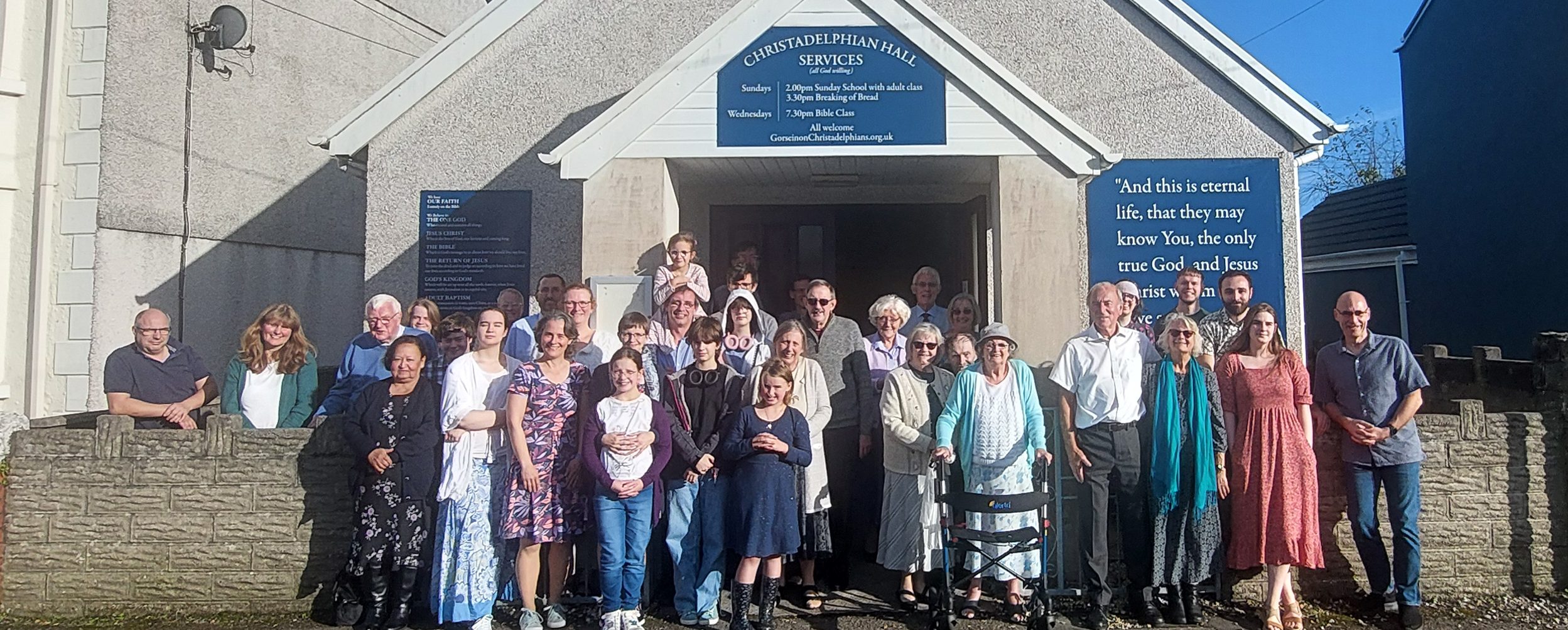
We will be starting “Learn to read the Bible Effectively”, weekly seminars, for 6 weeks from Tuesday, 22 October 2024, God willing. They will be at 7pm, at our hall (110 Pontardulais Road Gorseinon SA4 4FQ). Please come along if you are interested.



 Gorseinon Christadelphians